2026-08-02 · 3 min read
INOP or "Runs and Drives"? The One Word That Kills Your Day
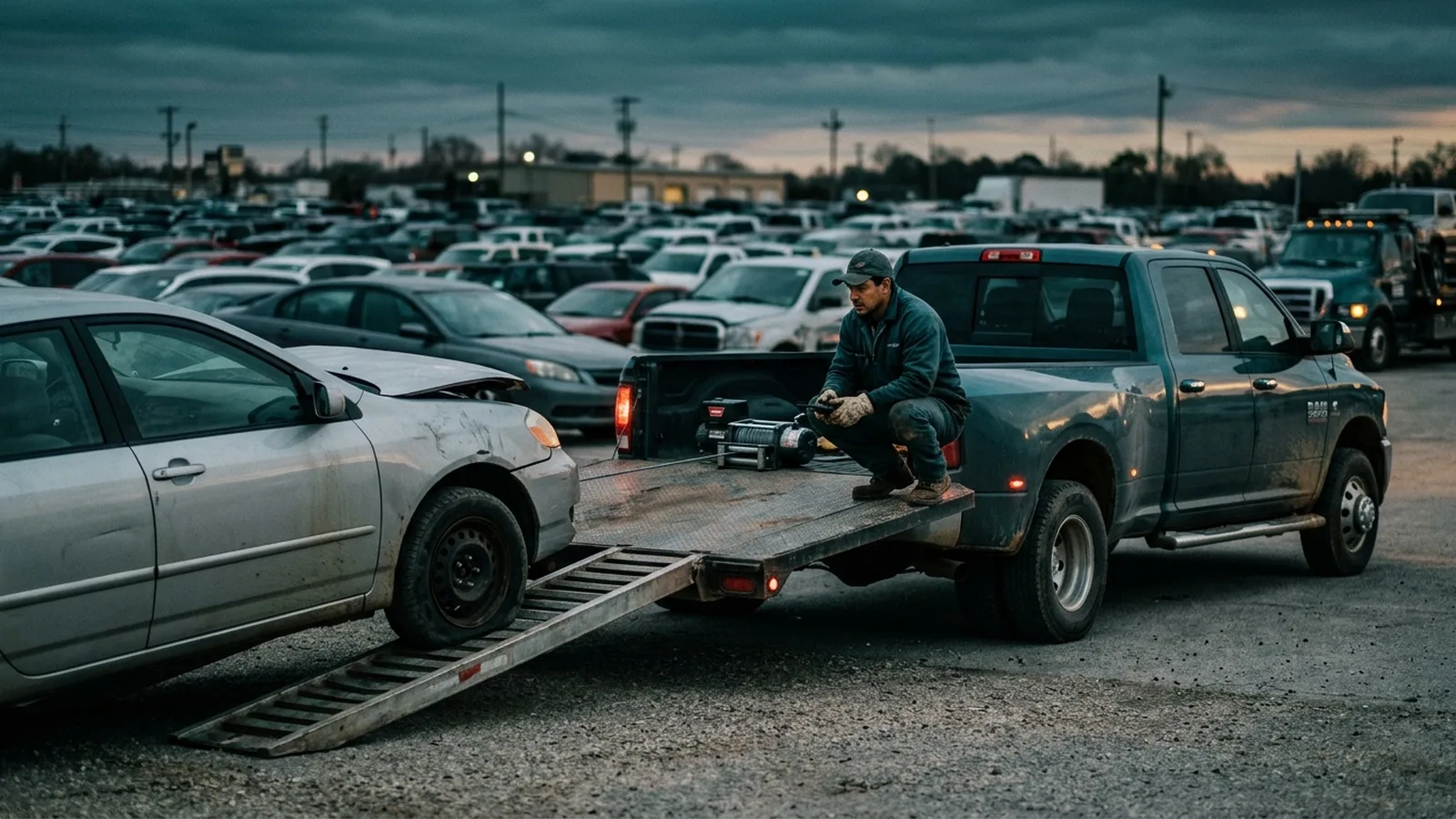
You accept the load on the board, deadhead 40 miles to the pickup, and the car the broker swore "runs and drives" has a seized engine. No winch on your setup, it does not load. With a winch, it loads — but you burned twice the time and got paid the rate for a car that rolls. Inop vehicle transport is one of the quietest ways to lose money in car hauling, and it almost always starts with one wrong word in the listing.
What INOP means (and why "runs and drives" misleads)
INOP is any vehicle that cannot move under its own power: it will not start, the battery is dead beyond a jump, a tire is destroyed, brakes or steering are broken, the engine is blown, or a wreck locked the wheels. Loading an INOP takes gear most hotshot wedges do not carry by default — a winch (the powered cable mounted on the trailer), heavy-duty ramps, sometimes a forklift to position a car that will not even steer.
The line between the two is thin and it is worth money: a dead battery that takes a jump is not INOP, it is operable. That single sentence is the difference between the standard rate and the INOP surcharge, which retail listings put in the neighborhood of $100–$200 more per unit. The surcharge existing is not the problem. The problem is when it never shows up in your rate because the car was advertised wrong.
What it changes for you
When the broker lists "runs and drives" and the reality at pickup is INOP, the cost does not disappear — it changes owners and lands in your pocket in three forms. Time: winching an INOP takes far longer than ramping a car that rolls. Equipment: with no winch, the load simply does not go up and the pickup fails. Risk: a badly secured INOP is a damage claim waiting to happen. And the rate you agreed to was the operable one.
The industry itself is blunt about what a bad classification causes: failed pickups, delays, extra transport cost, and canceled loads. Translated into your day — a car that will not load is a deadhead you paid for out of your own fuel, a slot in your week burned, and a TONU argument with the broker you now have to win on paper rather than on someone's word.
There is no magic number here for what you "will make" — results vary by carrier, market, equipment, and season. What you can control is not accepting INOP work at operable pricing. That math is yours, and it starts before you turn the key to go get the unit. A good dispatcher treats operable/INOP status as part of load selection, at the same level as RPM and distance, because one wrong field there destroys the math on a rate that looked fine in the screenshot.
In practice
Confirm operable/INOP in writing before you accept. The field exists on Central Dispatch and Super Dispatch — but get the broker to confirm "runs and drives" in the message thread. A screenshot outweighs memory when the conversation turns into TONU.
Ask for the cause, not just the label. "It is only the battery" is operable only if it takes a jump. A battery that will not take one, a tire on the ground, or locked steering is INOP, and the rate has to reflect the winch and the extra time.
Price INOP as INOP. If you carry a winch, charge for the service it represents. If you do not, know that the load is not yours and keep scrolling the board. Accepting INOP at an operable rate is subsidizing the broker with your own time.
In the end this is load due diligence — the same discipline that decides whether a rate is worth running before you roll. We are not a carrier and not a freight broker: we build the system that checks this kind of detail at load-selection time, so you do not discover the INOP only when the winch cable goes tight.
Sources
- Auto Hauler Exchange — Understanding the Difference Between Operable and Inoperable Vehicles: https://www.autohaulerexchange.com/blog/understanding-the-difference-between-operable-and-inoperable-vehicles
- Bold Auto Transport — Inoperable Vehicle Shipping: https://boldautotransport.com/inoperable-vehicle-shipping/
Individual results vary. Performance depends on equipment, lane, market conditions, and driver effort. Not a promise or guarantee of earnings.
Auto Hauler Exchange — operable vs. inoperable vehicles: https://www.autohaulerexchange.com/blog/understanding-the-difference-between-operable-and-inoperable-vehicles